The Brahms Third Symphony is the least often performed of the four the German master composed, not because it's music is any less great than the others, but more because many musicians claim it's the most difficult play. It also ends softly which in the business of orchestral concerts diminishes the audience's chance to stand up and cheer. Players confess they work the hardest to pull it off and the audience potentially gives them little reward. I mention this because if they do play well, remember that it's OK eventually to applaud loudly when a pieces ends quietly. Do, however, savor the quiet moment, but don't just walk away.
Reviews
2016-2017: Shakespeare in Music
The Californian – Russian violinist Sergej Krylov debuts with Symphony
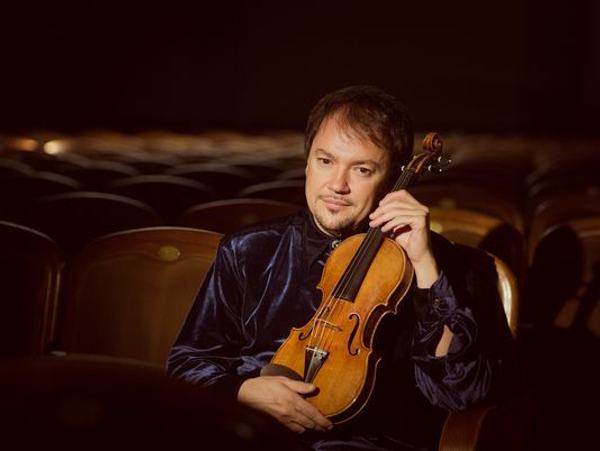 Sergej Krylov debuts with the Monterey Symphony
February 15, 2017
Symphony presents music by Beethoven, Sibelius and Brahms
Russian violinist Sergej Krylov will perform the Sibelius' Violin Concerto in D Minor with the Monterey Symphony in the orchestra's first performance in 2017. Concerts take place in Carmel at Sunset Theater, 8 p.m., Saturday, Feb. 18 and 3 p.m., Sunday, Feb. 19. Also on the program are Beethoven's Coriolan Overture and Brahms Symphony No. 3. Max Bragado-Darman conducts.
The orchestra's theme for this season "Shakespeare in Music" continues in this concert with a bit of a stretch to the bard's tragedy, "Coriolanus." Ludwig van Beethoven, however, composed his work in 1807 to accompany German playwright Heinrich Joseph von Collin's 1804 tragedy "Coriolan." Both plays have Gaius Marcius Coriolanus, a Roman general, as their primary character and both focus on the theme of loyalty to one's country and one's family versus personal ambition. No record exists as to how Coriolanus actually died. In von Collin's version of the story he kills himself and Shakespeare has him murdered. Regardless of the story's outcome, the music is memorable with warlike themes interspersed with more tender melodies. Curiously, the dramatic use of forte chords and extended pauses has recruited the work to be used to test the reverberation of concert halls. It will sound great in Sherwood Hall.