Reviews
2016-2017: Shakespeare in Music
Peninsula Reviews – Monterey Symphony – Midsummer Night's Dream
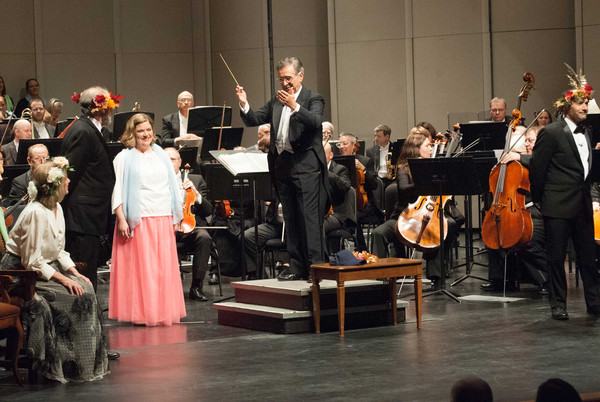
When the Monterey Symphony planned its 2016-2017 season with the theme "Shakespeare in Music," it couldn't have foreseen that its second concert featuring the Overture and Incidental Music to Mendelssohn's "A Midsummer Night's Dream" might be relevant to our nation's present precarious political situation. After an inflammatory sixteen-month election campaign, and its shocking outcome last week, our President-elect, Donald J. Trump, has appointed as White House chief strategist, Steve Bannon, who as former CEO of Breitbart News has harbored anti-Semitic, anti-Muslim and misogynistic views. Already Bannon is being called "the Darth Vadar" of Trump's cabinet.
We can only hope that the underlying white supremacist tendencies observed during the 2016 election campaign will not threaten or destroy our society during the next four years. Which brings us back to Mendelssohn. In 1933, during the Third Reich, Mendelssohn, as a "Jewish" composer (although he was raised as a Christian), was de-canonized from the pantheon of great composers, his music was banned, and on the night of November 9, 1936, a statue of him in front of the Leipzig Gewandhaus was torn down and replaced by flowerbeds. Recalling Mendelssohn's treatment during the Hitler years serves to remind us that anti-Semitic prejudice is an evil still threatening us today.
Hearing the "Overture to a Midsummer Night's Dream" is a partial antidote to these fears and remains today a powerful musical experience that continues to move and charm us. Written in 1826, when he was only 17, it is a remarkable feat of precocity at a time his exact contemporaries, Liszt, Schumann and Chopin, were still producing juvenilia. The opening of this work, with its ambiguous four chords for winds followed by the elf-like passages in the strings sounded as magical as ever in the performance we heard last night by the Monterey Symphony, directed by Max Bragado-Darman.
Since we were also hearing the incidental music for Midsummer Night's Dream, written almost sixteen years after the Overture, every inch of the stage at Sunset Center was crowded to the gills to accommodate the chorus of I Cantori di Carmel (prepared by Sal Ferantelli), participating young musicians from Youth Music Monterey County and soloists Mary Young Bragado, Angelique Zuluaga, Michael Jacobs and Doug Toby. Jacobs and Toby gave us narration (plus a bit of singing), and the soloists played multiple parts using a variety of props. Considering that over half of the audience is over 60 and probably has some slight degree of hearing loss, it was not always easy to understand some of the narration and singing. Hamlet may have said, "The Play's the Thing," but on this occasion it was more like, "The Music's the Thing" and indeed, the music carried the day.
The concert began with a strong and compelling performance of Brahms "Variations on a Theme by Haydn," an orchestrated theme and variations on the popular "St. Anthony's Chorale. We have to say that Mendelssohn's influence needs to be mentioned here. After the deaths of Carl Maria von Weber in 1826, Beethoven in 1827 and Schubert in 1828, Europe's musical center moved from Vienna to Paris where audiences were obsessed with opera — one of the Rothschilds commissioned the set designer of the Paris Opera to decorate the public rooms of his chateau outside Paris with scenes from his favorite operas. Composers wrote endless superficial variations, paraphrases and potpourris for piano based on tunes from fashionable operas. This corruption and degradation of the noble art of the variation genre inspired Mendelssohn in 1840 to compose his Variations sérieuses, Op. 54, which had a strong influence on Schumann and Brahms.